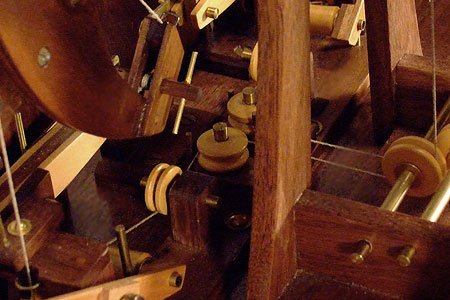
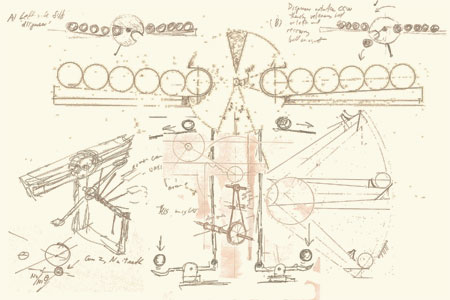
The action of this machine is very complex, mainly due to all the pulleys, triggering devices, and compensating mechanisms needed to facilitate the main movements.
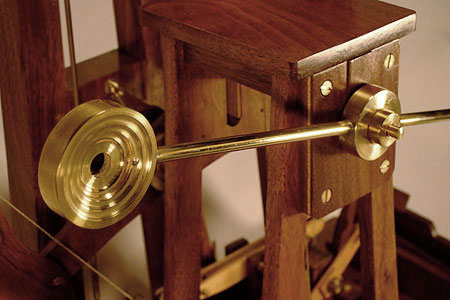
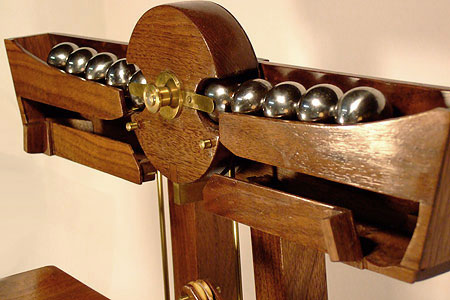
A brass "propeller" is attached to a wooden "see-saw"-shaped arm through a cord that snakes through a maze of pulleys. When the propeller is spun, the arm rises until it hits a trigger that releases one of 10 steel balls from a dispensing mechanism. (It's the weight of each falling ball that powers the machine beyond the initial spin.)
As the arm lowers the ball into a receiving trough, the propeller spins in the opposition direction, which causes the other end of the arm to rise until it triggers the release of another ball, and the entire process repeats itself.
In some ways, this visually satisfying machine is a more authoritative, masculine version of my "Art Deco Elegance And The Mystery Arm" machine.
The base and structure are made of walnut and the metal parts are made of brass. The pulleys and the decorative inlays are made of boxwood.
The rotating brass "propeller" runs on ball bearings and is thus very smooth in operation.
Aesthetically, parts of this machine have a vaguely Japanese archway-like shape to them, which was deliberate.
Approximate Dimensions: 19" long x 12" deep x 18" high. Steel Balls: 1" in diameter.
How it went? Quite frankly, not well! While not my largest machine, this one was easily the most technically challenging and problematic. The basic issue was that a great deal was being asked of a small steel ball falling less than a foot, for it contains a very limited amount of energy.
The main enemy (as always) is friction. By far, the biggest headache was trying maintain constant tension in the cord. Too much friction, and it freezes up...too little, and you have slippage. Therefore, all of the complex shapes and weighted pulleys were made to regulate this.
Wait, I'm still not done complaining! Designing and constructing a mechanism capable of triggering the ball dispenser at the precise moment when the other ball is released into the trough was truly a vexing problem, one that almost caused me to call it quits.
This machine is a perfect example of how a simple concept can get totally out of hand once one tries to translate it into an actual functioning piece. Although I managed to solve the above problems (as well as some others I haven't even mentioned), this is still a very sensitive and temperamental machine. I'm glad I finished it before I was sacrificed at the altar of complexity!