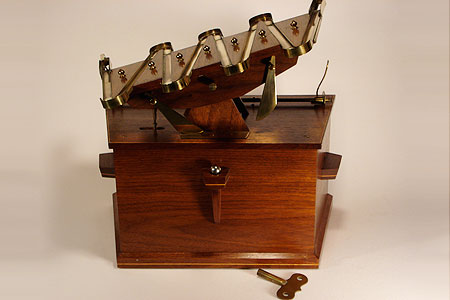
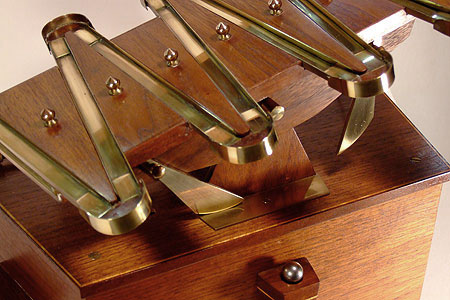
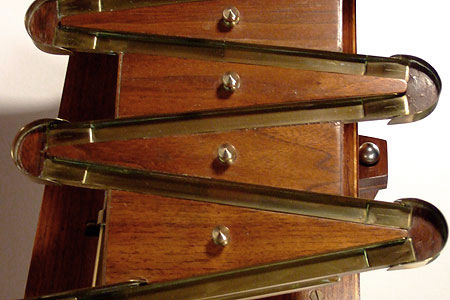
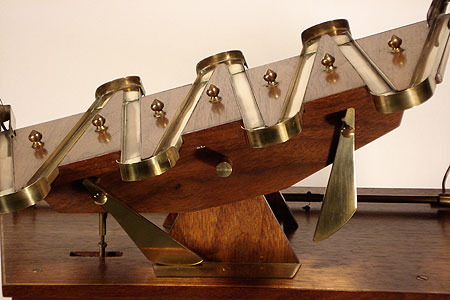
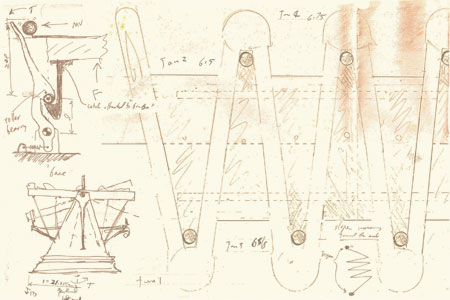
A steel ball rolls down a zig-zag track, which is recessed into a pivoted inclined platform, which is in turn mounted on top of a box containing a wind-up, spring-driven clockwork mechanism.
When the ball completes its downward journey, it hits a trigger that causes the clockwork mechanism to tilt the platform in the opposite direction with an authoritative 'clank'. The ball then rolls down the zig-zag track in the opposite direction before hitting the trigger at that end, and the process repeats itself.
This alternating back-and-forth action continues for about 8 minutes before the machine comes to a stop when the clockwork spring winds down.
This machine is not only hypnotic to watch, the zig-zagging ball makes a very pleasing sound as it zips around the track.
The box and tilting table are made of walnut with decorative maple inlay trim, and the recessed track and all of the external metal parts are made of brass.
The 5/8" steel ball is kept in a built-in magnetic receptacle that's located in the front of the box.
The hidden clockwork mechanism is accessible through a removable panel in the rear of the machine, where the winding key is stored in a holder when not in use.
Approximate Dimensions: 16" long x 11" deep x 16" high. (Though not overly large, this piece has a rather substantial heft to it.)
This damnable machine posed a host of vexing problems from the very beginning. In fact, the one shown here is actually my third version--the first one didn't look right, and I destroyed the second one with an axe after many futile hours of work. (I think it was laughing at me, but I had the last laugh...Ho ho!)
What turned out to be a seemingly insurmountable problem was designing a trigger mechanism sensitive enough to be set off by the light impact of a small steel ball. Friction was the enemy, and I had to try no less than four different types of triggers.
Another difficult problem was making the clockwork mechanism tilt the table in a reasonably smooth and consistent manner over the full range of the winding cycle. Unless I could smooth out the tension in the spring, the tilting of the table would be too violent at the start and too sluggish toward the end. This I accomplished by means of a tapered spiral 'fusee wheel', a mechanism first used in 15th Century cathedral clocks for the exact same purpose.
Indeed, while this machine turned out to be a very stubborn collection of technical problems, through perseverance and some creative mechanical design, it was finally made to work. Quite frankly, if I had known it was going to be this much trouble I never would have started it!