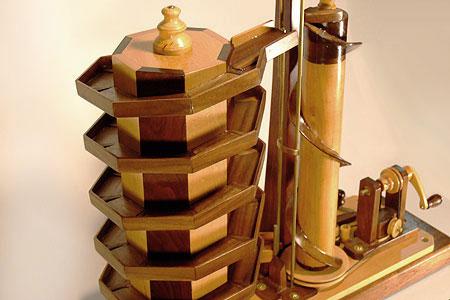
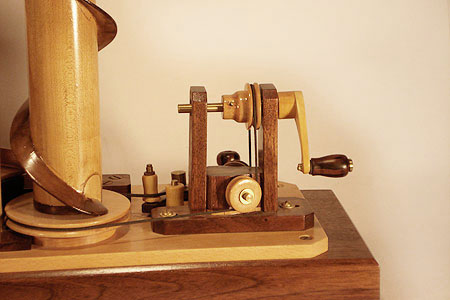
When the hand crank is repeatedly turned, it rotates a spiraled cylinder which is connected to the crank through a series of pulleys.
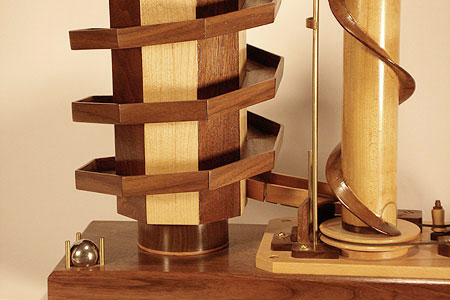
This cylinder then scoops a steel ball up onto its spiral track. (The ball is kept from falling off by two fixed metal rods.) Once the ball reaches the top, it drops into a large, octagonally-shaped spiral structure.
After ricocheting its way down the octagonal track with a funky clacking sound, the ball is deposited in the trough until it's scooped up again for another ride up the spiral cylinder.
This particular machine is very much about wood!
The main base is walnut, and the support base for the crank mechanism is beech. The main part of the spiral cylinder is actually made from a beech rolling pin. The spiral track wrapped around this pin is made up of many individual walnut segments covered with a mixture of epoxy and walnut sanding dust that was painstakingly shaped to form a smooth, glossy 'composite' material.
The large octagonal structure is made up of alternating segments of carefully fitted walnut and maple. The upper end of the octagonal cylinder is quarter-sawn sycamore topped by a delicately turned boxwood cap. While the pulleys are made of boxwood and maple, the crank handle and belt tension-adjusting knob are macassar ebony.
The belt happens to be a well-aged round shoelace. (I prize old shoelaces for these things, as they have acquired good flexibility from miles of walking.)
Approximate Dimensions: 18.5" long x 6.5" deep x 18" high.
While this machine took some careful planning, and had its share of problems, it's actually not a complex piece from a purely technical standpoint. However, thanks to its visual, auditory, and interactive qualities, this machine is not only the most addictive to play with, it's a fine example of my woodworking.
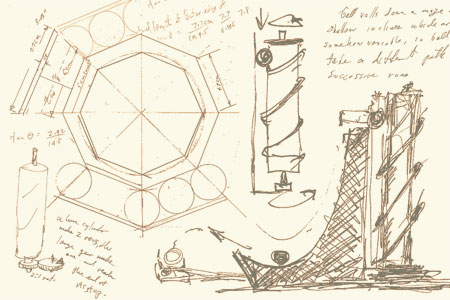
Essentially, to make the octagonal structure, four pieces (each of walnut and maple) had to be carefully shaped and hand-fitted into an octagon cross-section. Since the octagonal track consists of 38 individual walnut segments, this task took me at least 38 hours to complete. Plus, it was extremely taxing making the spiral that scoops up the ball.
On the other hand, since I just love to make tiny wooden pulleys, making the pulleys and turning the boxwood caps was actually the fun part. (By the way, boxwood is an exceptional wood for finely detailed small pieces, as it has a texture more like ivory than wood.)
Finally, since my late mother never seemed to appreciate my machines, I used one of her old, kitchen rolling pins as the main part of the spiral cylinder. (Ha!)